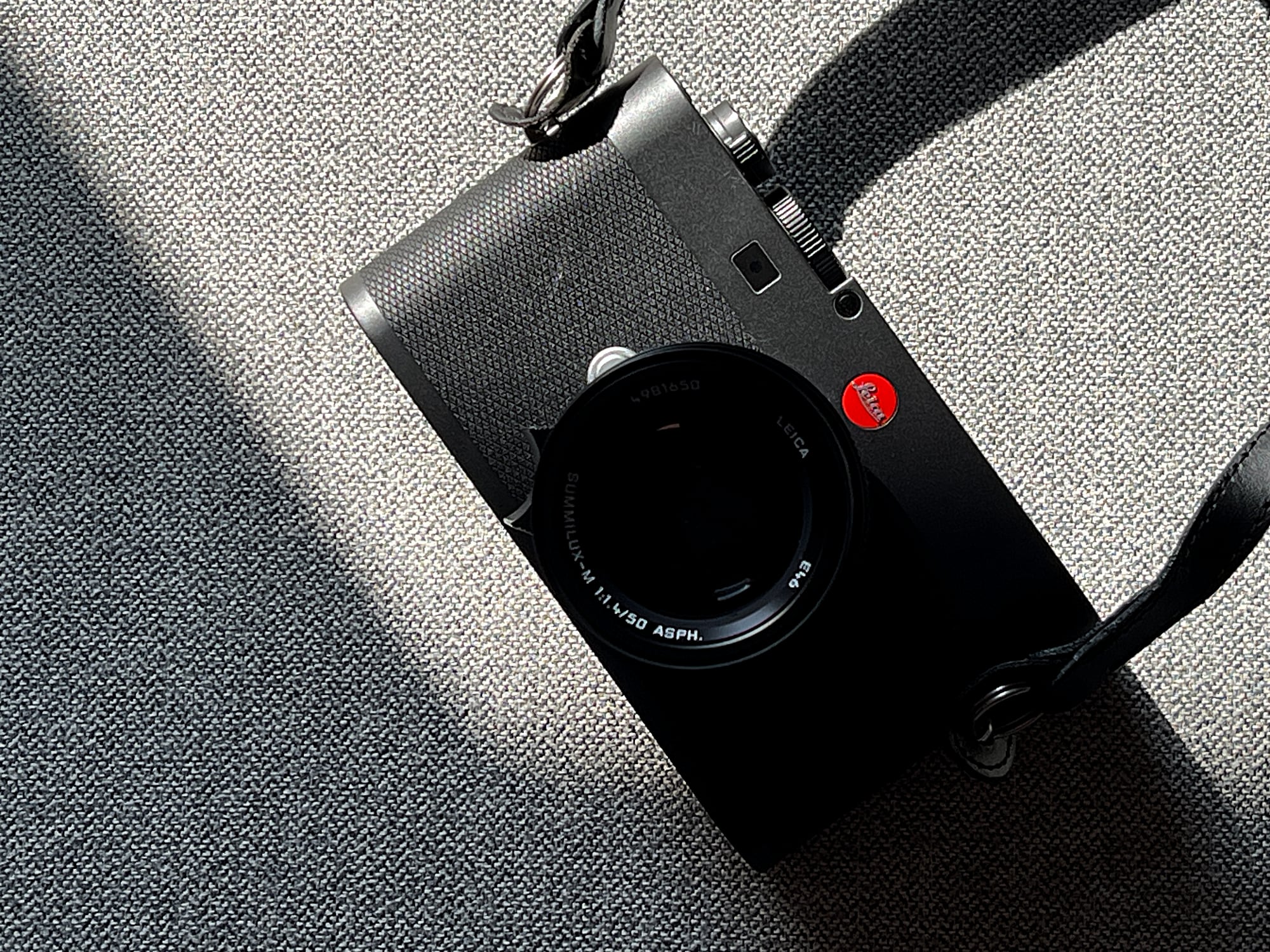
In the long arc of Leica’s M story, the M EV1 feels less like a new chapter and more like a fork in the road. Announced last October, it is the first M without a rangefinder, replacing the optical window with a built-in 5.76‑million‑dot OLED electronic viewfinder (EVF). For traditionalists, that single specification borders on heresy. For others, it is liberation.
- Price: S$11,950 (body only), get it at Leica Store
- Image sensor: 60-megapixel backside-illuminated CMOS full-frame
- Image processor: Maestro-III
- Internal storage: 64GB
- Memory card slot: SD card
- Connectivity: Bluetooth
- Weight: 495g (body only, with battery and SD card)
| PROS | CONS |
| Excellent image quality | Expensive (It is a Leica!) |
| Sharp and bright 5.76‑million‑dot EVF | No rangefinder (not for traditionalists) |
| Great accuracy when shooting | |
| Still a M rangefinder |
For this review, Leica loaned me the Summilux‑M 50mm f/1.4 Glossy Black (S$6,550, get it at Leica Store) to use with the M EV1. Fantastic combination. Period.
Back to the camera. At its core, the M EV1 is built on familiar foundations. It carries the same 60MP full-frame BSI CMOS sensor and Maestro III processor as the M11, complete with Leica’s Triple Resolution Technology (60MP, 36MP or 18MP in DNG or JPEG). Image quality, as expected, is not in question. It is going to be excellent, only the photographer will fail the camera.

What has changed is how you see. The EVF — similar in spirit to the Q3 — offers real-time exposure preview, focus peaking and magnification. These are tools a traditional optical rangefinder simply cannot provide. The familiar front lever, once used for frame-line preview, is now programmable for focus assist or digital zoom. Mechanically, it still feels like an M. Experientially, it is decisively electronic.

Physically, the EV1 remains unmistakably Leica. The milled metal chassis, handmade in Germany, retains that dense, reassuring weight. There is 64GB of internal storage alongside SD support, plus Bluetooth and Wi‑Fi connectivity via the Leica FOTOS app. In the hand, it is still every inch an M.

In essence, this is an M11 reimagined around an EVF. But that shift changes more than it sounds. With an EVF, the M EV1 becomes far more versatile. Ultra-wides, longer focal lengths and even close-up work will feel more precise and less compromised. Focus peaking and magnification remove guesswork. Real-time exposure preview shows you exactly what you are getting. When shooting wide open at f/1.4, the margin for error is razor thin — and the EV1 makes that margin visible.
This is not about bad eyesight (though for middle-age guys with failing eyesight like myself, I will admit the clarity helps), it is about accuracy. It is about seeing depth of field and critical focus in real time, rather than trusting calibration and muscle memory.

Using the M EV1, I could not escape the feeling that this is a turning point — not because it replaces the traditional M, but because it reframes what an M can be. There is a growing group of photographers who value precision over ritual. For them, the EV1 does not reject heritage; it offers an alternative path through it.

In use, it is arguably the most straightforward M I have handled. The experience feels closer to a Q3 (including the leatherette feel) in temperament — responsive, clear, confident — but with the freedom of the M mount. The EVF is crisp and immersive, and after extended use, it stops feeling like a compromise and starts feeling like clarity.
Still, the debate is inevitable. For many long-time M users, removing the rangefinder removes the soul. The M has historically been defined by its mechanically coupled focusing system — the bright-line frames, the discipline of alignment, the tactile ritual. That identity shaped generations of photographers.

The M EV1 asks a philosophical question: Is the M defined by its mount, or by its rangefinder?
Leica has faced resistance before, such as the M8’s move to CMOS, or the M11’s internal storage. The company evolves slowly, but it certainly evolves. Importantly, the EV1 does not replace the optical M. It exists alongside it. Traditional rangefinder models remain for those who want the classic experience. The EV1 is simply another option.

Then there is the price: S$11,950 (body only). Very expensive. At nearly twelve thousand dollars, it competes not just with other Leicas but with highly capable mirrorless systems offering faster autofocus, higher burst rates and extensive video features. But Leica has never competed on feature density but on reduction.
VERDICT: The Leica M EV1 is not a betrayal. It is a clarification. It strips away the romance of the optical finder and asks a harder question – if you remove the ritual, does the image improve?

For photographers who demand critical focus at shallow depth of field, the answer may well be yes. For others, the rangefinder remains the point. The quiet genius of the EV1 is that it does not end the debate about what an M should be. It makes that debate explicit. And at this level, no Leica has ever been a casual decision.