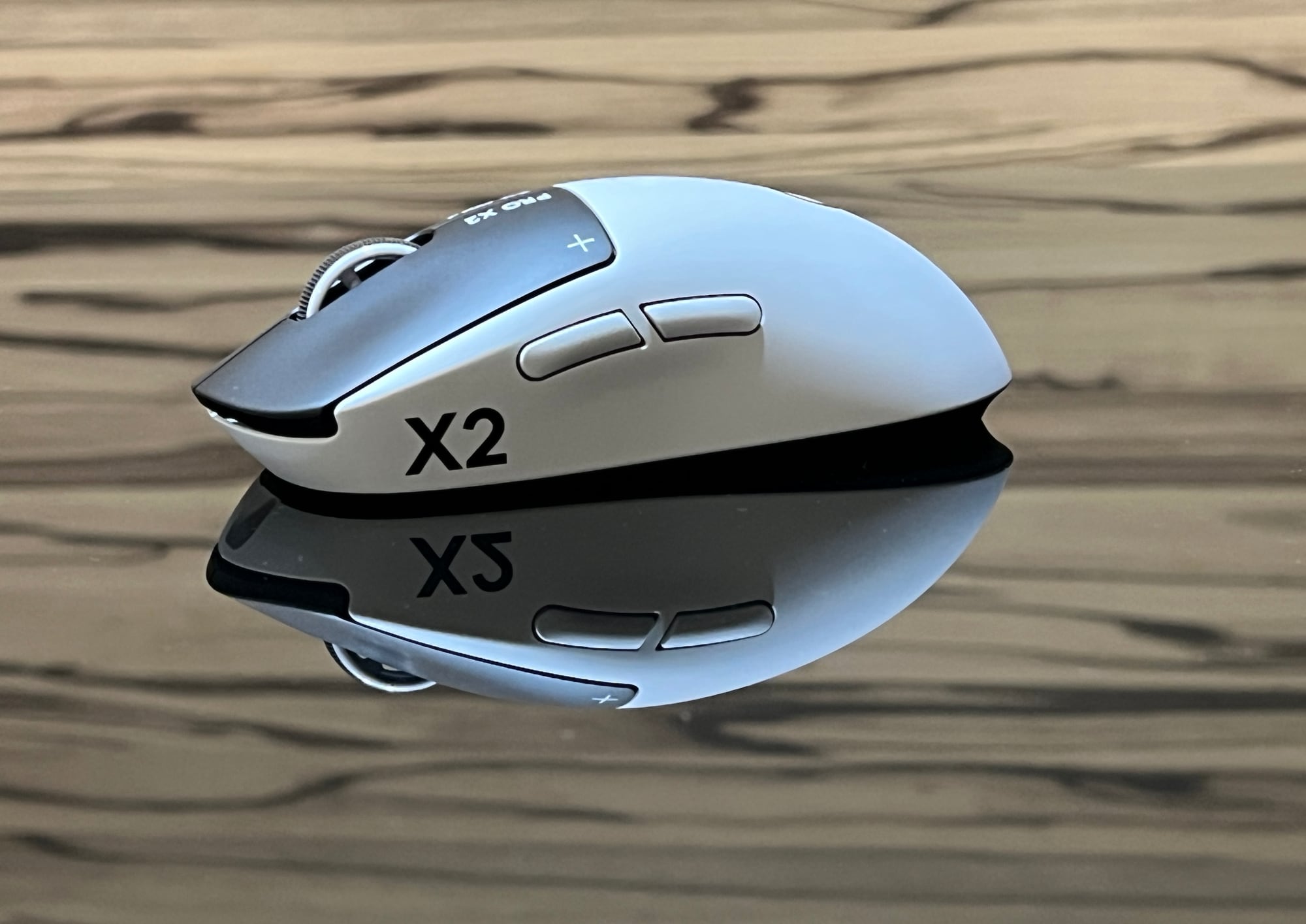
For the longest time, gaming mice have felt like they were stuck in an arms race that didn’t really matter. Higher DPI numbers, lighter shells, faster polling rates – all impressive on a spec sheet, but rarely transformative once you are actually using the gaming mouse itself. The Logitech G Pro X2 Superstrike is one of the few recent releases that genuinely feels different. Not just incrementally better, but meaningfully rethought.
- Price: S$289, get it at Shopee and Lazada
- Sensor: HERO 2
- Number of buttons: 5
- Connectivity: USB-C, LIGHTSPEED (2.4GHz) and PowerPlay
- Resolution: 100 to 44,000 DPI
- Maximum speed: 888 IPS
- Maximum polling rate: 8,000Hz
- Maximum acceleration: 8G
- Maximum wired polling rate: 1,000Hz
- Compatibility: Windows or macOS with an available USB 2.0 (or higher) port
- Weight: 61g
| PROS | CONS |
| Innovative inductive analog sensing and real-time click haptics technology | Expensive |
| Incredibly responsive | No dedicated DPI button |
| Very customisable | Only 5 buttons |
| Symmetrical design for all users | No Bluetooth |
| Very lightweight |
At first glance, the Superstrike doesn’t look revolutionary. It borrows the exact same shell as the Logitech G Pro X Superlight 2, which I reviewed over 5 years ago. It has the same symmetrical, medium-sized shape that has already proven itself on esports stages around the world. We are still looking at a 61g chassis, a five-button layout, no RGB lighting, and no DPI button. It is minimal, purpose-built, and unapologetically competitive. If you’ve used a Superlight (like the Superlight 2 DEX) before, this will feel instantly familiar in hand.

But inside, everything changes. The headline feature of the Logitech G Pro X2 Superstrike is what Logitech calls HITS — the Haptic Inductive Trigger System. Instead of traditional mechanical or optical switches beneath the left and right mouse buttons, the Superstrike uses electromagnetic induction to detect how far the button has been pressed. A haptic motor then simulates the tactile feedback of a click.
In other words, there is no physical click mechanism anymore. That might sound gimmicky at first, but the implications are significant. Because actuation is detected magnetically, you can adjust the click point across multiple levels. Logitech allows you to reduce actuation to as little as 0.1mm of travel, which is dramatically shorter than the roughly 0.6mm typical of conventional gaming mice. Less travel means less delay between intention and input. Logitech claims up to 30ms of improvement compared to traditional switches. In competitive esports, these 30ms might be the difference between victory and defeat.

Using Human Benchmark reaction test, I compared the Superstrike with the Superlight 2 DEX. I found the Superstrike’s reaction times to be between 19ms to 28ms faster than the Superlight. So, it is pretty near to 30ms improvement as advertised.
However, it is more surprising how noticeable it feels even navigating Windows, the clicks feel sharper and more immediate. In-game, particularly in first-person shooter (FPS) titles like CounterStrike 2, Battlefield 6 or even Fallout 4 (yes, I am still playing it), single-tap weapons feel more responsive. There’s a subtle but perceptible tightening of the connection between thought and action. It doesn’t magically make you better, but it does narrow the margin.

Then there’s Rapid Trigger support — a feature borrowed from Hall-effect keyboard technology. Instead of relying on a fixed reset point, clicks can reset dynamically based on movement direction. This allows faster repeat clicks without fully releasing the button. For players who rely on rapid tapping or precise micro-adjustments, this adds another layer of responsiveness. This is especially true, when I was playing Diablo 4 .
Of course, without physical switches, the mouse needs to replicate tactile feedback convincingly, and this is where Logitech’s haptics shine. You can choose between five levels of feedback strength. At higher settings, the click feels weighty and mechanical-like. At lower levels, it is crisp and lighter. It does not perfectly mimic a traditional microswitch as there is a slightly rounded quality to it. But adaptation happens quickly. After a few games, it feels natural. In fact, turning the haptics off entirely makes the mouse feel strangely lifeless, underscoring how well the system works.
Beyond the click technology, the Superstrike remains a flagship-tier gaming mouse. The HERO 2 sensor delivers up to 44,000 DPI, 888 IPS tracking, and 88G acceleration. In practical use, tracking is flawless. There is no smoothing, no jitter, or unexpected behaviour. The 8,000Hz polling rate over Lightspeed wireless is available for those who want it, though many competitive players (or leisure players like myself) will likely stick to 1,000Hz for stability.

Battery life is rated at up to 90 hours, due to the power demands of the haptic system. In real-world use with moderate haptic intensity, endurance lands comfortably within the 80–90 hour range. Still, that is more than sufficient for competitive play or most scenarios. Not to mention, charging via USB-C is straightforward.
Logitech G Hub handles all the configuration. You can adjust DPI, polling rate, button assignments, and, crucially, the HITS settings — including actuation distance, Rapid Trigger sensitivity, and haptic strength. The interface provides live feedback on button travel, making it easier to fine-tune to your preference. Profiles can be saved per game, allowing you to run aggressive hair-trigger settings for FPS titles, as well as more deliberate actuation for general productivity.

There are trade-offs, of course. There is no Bluetooth connectivity, as this is strictly a wired or 2.4GHz LIGHTSPEED device. The five-button layout may feel limiting for MMO players. The absence of a physical DPI button might frustrate some too. And at S$289, this sits firmly in the premium territory.
But the bigger question is whether the Logitech G Pro X2 Superstrike justifies its price with genuine innovation. The answer is yes. It will not replace practice or bad crosshair placement. But it does give you a measurable mechanical edge, which in competitive gaming, even small advantages matter.
VERDICT: For serious FPS players and esports enthusiasts chasing every millisecond of advantage, the Logitech G Pro X2 Superstrike is not just another upgrade but a glimpse into where gaming mouse technology is heading next.
One thought on “Logitech G Pro X2 Superstrike Review: The Fastest Wireless Gaming Mouse Yet?”